Quite a few collaboration agreements have been introduced between US and UK companions geared toward accelerating the industrial deployment of nuclear fusion energy crops all over the world.
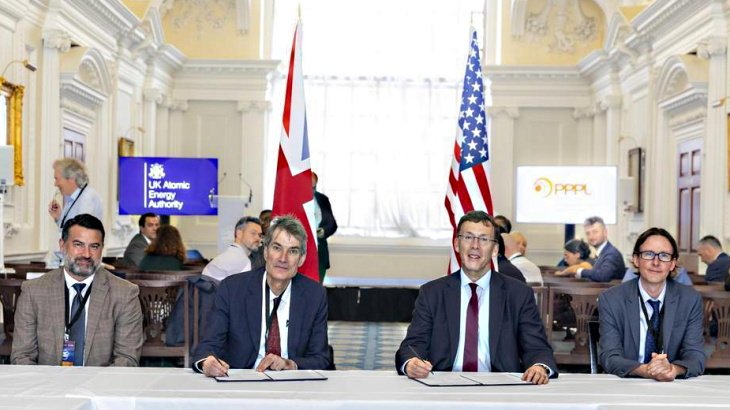
Firstly, the UK Atomic Vitality Authority (UKAEA) and the US Division of Vitality’s Princeton Plasma Physics Laboratory (PPPL) have signed a joint declaration of intent to discover linking their superior fusion supercomputing platforms, utilizing synthetic intelligence to speed up fusion power’s improvement.
Underneath the joint declaration – signed on the World Fusion Coverage Summit in London on Monday – UKAEA’s SUNRISE mission-focused AI supercomputer can be linked with PPPL’s Simulation, Expertise and Experiment Leveraging Studying-Accelerated Analysis (STELLAR-AI) platform by a partnership referred to as the SUNRISE–STELLAR-AI Federation. SUNRISE is the UK’s first AI supercomputer devoted to fusion power, backed by GBP45 million (USD60.6 million) from the UK authorities. STELLAR-AI is PPPL’s USD13 million AI and high-performance computing platform to be operated with help from Princeton College. STELLAR-AI is designed to host AI instruments and workflows as they mature.
The collaboration – which builds on a memorandum of understanding signed between UKAEA and PPPL in June – would draw on experiments accomplished utilizing UKAEA’s MAST Improve facility in Oxfordshire and PPPL’s NSTX-U facility in New Jersey. The federation will imply each superior computer systems can be used to coach the identical AI fashions, which want massive volumes of high-quality information to make correct predictions.
Linking the 2 laptop programs will let researchers on either side of the Atlantic share experimental information, prepare AI on the outcomes of two totally different experimental fusion amenities and run their fashions on the machine finest suited to the duty, PPPL famous. Each MAST Improve and NSTX-U are compact spherical tokamaks with related designs, making them effectively suited to joint AI coaching.
“When totally different amenities are mixed, researchers can develop extra highly effective machine-learning fashions that higher seize the underlying physics and assist speed up future fusion tasks, together with the UK’s Spherical Tokamak for Vitality Manufacturing (STEP Fusion) and US ideas reminiscent of PPPL’s Spherical Tokamak Superior Reactor (STAR),” UKAEA mentioned.
“Fusion is without doubt one of the nice scientific and engineering challenges of our time,” mentioned Joe Milnes, Govt Director for Engineering and Computing at UKAEA. “To unravel these challenges, fusion wants partnerships. The US and UK are two international leaders in fusion analysis, and the federation of SUNRISE and STELLAR-AI would construct on a protracted historical past of transatlantic cooperation to additional advance fusion improvement.”
“UKAEA and PPPL would draw on experimental information from two world-leading fusion machines, utilizing simulation to fill the gaps and lengthen these datasets into regimes we now have but to discover,” added Rob Akers, Director of Computing Programmes and Senior Fellow at UKAEA. “Collectively, we are able to develop digital twins of each machines to help the design of future fusion energy crops, creating fashions of spherical tokamaks which are extra predictive, extra actionable and in the end extra helpful to fusion engineers. The actual energy will come from working as one workforce. Collectively, we are able to study quicker and study extra, extracting most perception. The computing and worldwide collaboration will assist us speed up the journey from as we speak’s experiments to tomorrow’s fusion energy crops.”
Jonathan Menard, Chief Scientist at PPPL, mentioned: “A fusion energy plant is without doubt one of the most complicated machines humanity has ever tried to construct and no single laboratory or nation will design it alone. By federating the SUNRISE and STELLAR-AI laptop platforms, we are able to prepare AI on information from two main fusion amenities, check concepts throughout two of probably the most succesful computing programs on the planet which are designed for fusion analysis, and speed up the trail to a compact fusion energy plant.”
“Our purpose is to let fashions and experiments transfer freely between the 2 programs,” mentioned Shantenu Jha, Head of Computational Sciences at PPPL. “We are going to flip a set of supercomputers right into a single engine for fusion discovery.”
The companions plan to increase the federation over time, with the long-term purpose of a shared basis mannequin for spherical tokamaks and, ultimately, a wider vary of tokamak configurations.
Shielding supplies
The UK’s College of Birmingham and US impartial, nonprofit power analysis and improvement organisation EPRI have introduced a serious collaboration to advance the event of fusion power applied sciences by the FURESHMA (Fusion Reactor Shielding Supplies) programme.
FURESHMA goals to check superior boride and carbide shielding supplies able to defending essential parts from the acute situations inside future fusion energy crops. The undertaking addresses a key barrier to industrial fusion power by enhancing the sturdiness, reliability and long-term efficiency of protecting supplies uncovered to intense neutron irradiation.
The GBP2.63 million collaboration has been funded by the UKRI Engineering & Bodily Sciences Analysis Council and EPRI, with extra participation of Aspect Six, constructing on the partnership initially arrange with Tokamak Vitality.
The collaboration brings collectively the college’s internationally recognised experience in fusion supplies with EPRI’s in depth expertise in power analysis, nuclear supplies and know-how deployment.
Constructing on current EPRI-Birmingham analysis and improvement, this collaboration connects modern analysis with the sensible necessities of future industrial fusion amenities. It’ll additionally help know-how switch and speed up the trail from laboratory discoveries to real-world power functions. The College of Birmingham and EPRI have agreed that information generated by the undertaking can be made brazenly out there, serving to the UK trade and the broader international fusion group profit from the findings.
“Fusion power has the potential to supply a safe, low-carbon supply of energy for future generations, however industrial deployment will depend on creating supplies able to withstanding fusion’s excessive situations by way of temperatures, irradiation doses and thermo-mechanical stresses,” mentioned Professor Arunodaya Bhattacharya, Chair in Fusion Vitality on the College of Birmingham and Deputy Head of Analysis within the College of Metallurgy and Supplies. “By combining the College of Birmingham’s world-leading experience in fusion supplies with EPRI’s deep understanding of the power sector, we are able to speed up the options that can convey fusion energy to grid.”
Steve Chengelis, EPRI Vice President, Nuclear Growth and Fusion, added: “Creating fusion energy crops which are buildable, dependable and maintainable would require a deeper understanding of how key supplies carry out underneath fusion situations. Via FURESHMA, EPRI and the College of Birmingham can join superior supplies analysis with the wants of future plant builders and operators, strengthen worldwide information change, and assist set up a sound technical basis for fusion deployment.”
Tennessee, UKAEA improve cooperation
In the meantime, the State of Tennessee, the Tennessee Valley Authority (TVA), and the UK have introduced a strengthened partnership to speed up the industrial deployment of fusion power, specializing in provide chains, workforce improvement, and enabling regulatory pathways that help secure and fast industrial scale-up.
The collaboration builds on momentum from fusion tasks underway in each Tennessee and the UK, together with Mission Infinity in Tennessee and the UK Infinity Fusion Consortium, which hyperlink experience from Sort One Vitality, TVA, Tokamak Vitality, Oak Ridge Nationwide Laboratory (ORNL), the UKAEA, and companions throughout the fusion provide chain. Tennessee’s fusion-specific licensing framework – enacted in June 2026 – equally mirrors the UK’s proportionate strategy underneath the UK Vitality Act 2023, making certain regulatory pathways that help secure and fast industrial scale-up.
The companions will discover cooperation in areas together with: strengthening fusion provide chains and superior manufacturing in each jurisdictions; improvement of the fusion gasoline cycle, together with tritium dealing with, lithium enrichment, and breeding blanket supplies; scientific and technical change between ORNL, the UKAEA, universities, nationwide laboratories, and analysis establishments; engagement amongst utilities, builders, buyers, and industrial companions on siting, interconnection, and offtake planning; workforce improvement, apprenticeships, and expertise change; coordination on fusion regulation, licensing, and security frameworks; and joint conferences, boards, and actions that help international fusion sector development.