That interplay captures one thing elemental about FU-Tone and Reiver: He’s one in all us. “I am only a guitar participant such as you, or some child in Kansas, or the man on the quilt of Rolling Stone,” he says.
This connection isn’t only a customer support quirk. It reveals a philosophy on the coronary heart of his model. From the early days of designing the EVH D-Tuna to the current, this strategy has formed FU-Tone right into a tight-knit group of devoted musicians from all walks of life.
It additionally explains why a lot of what Reiver builds and talks about facilities on serving to gamers take full management of their tone—not simply upgrading their devices, however understanding them.
Customized FU-Tone tremolo bridge with EVH D-Tuna and locking nut.
Picture by Nadine Pleasure
To totally grasp how deeply this mindset is embedded, it helps to take a look at Reiver’s personal journey as a participant. His story started at a second when guitar tradition dominated the world, throughout a shift from conventional sounds into extra experimental territory.
“It was round ’81 once I first actually discovered the guitar,” he says. “And in case you roll the clock again two or three years from there, it was mainly, ‘Would you like a Strat, a Tele, or a Les Paul?’ After which off you go. I didn’t assume modding and hot-rodding guitars had been a factor.”
Reiver was there at floor zero to witness the shift towards custom-made superstrats, the rise of early custom-shop manufacturers like Jackson and Charvel, and brand-new horizons in enjoying approach. Not losing any time, he jumped in headfirst, changing into fascinated with how he may change, enhance, and utterly reimagine his favourite devices.
“My first guitar was like an affordable, $200 Hondo Flying V,” he says with a contact of satisfaction. “However by the point I used to be accomplished with it, it had a Kahler in there. It had an Invader pickup within the bridge. It had a Mighty Mite triple-coil pickup within the neck. It was like, do something you might do to only tinker and play with the guitar.”
Nearly everybody who’s performed electrical guitar for any period of time is accustomed to that unexplainable pull to hot-rod their favourite instrument. In Reiver’s case, nevertheless, it was greater than curiosity. It was a brand new paradigm. The guitar was not a completed product. It was a platform.
“The appearance of FU-Tone was, ‘How do you make this guitar sound higher?’”
Whereas different tinkerers of his period pursued those self same targets by winding pickups, constructing guitars, and including wild finishes, Reiver’s curiosity discovered its outlet in fabrication. Due to his highschool’s metallic store, he wasn’t modifying present components—he was making new ones.
“I used to be not a very good scholar, apart from that class,” he remembers with amusing. “I acquired straight As in metallic store. I favored how you might fabricate components from an concept in your head. Like, ‘How will we do that? How will we get this concept from right here to there?’”
That have translated instantly into how he would later develop merchandise. Even earlier than founding Floyd Upgrades—FU-Tone’s authentic title—his course of was easy and fast. Draw one thing, construct it, check it, refine it. Nonetheless, Reiver admits he’s no machinist.
“I do know sufficient simply to be harmful, simply to get myself in bother. So I contracted with this man who was knowledgeable machinist. I might actually sketch one thing on the aspect of a field and say, ‘Are you able to make this?’ He would whip it up old-school and convey it again to my workplace.”
This spirit of experimentation wasn’t simply restricted to these early years. That very same trial-and-error strategy nonetheless defines FU-Tone merchandise right now. As a substitute of designing in isolation, Reiver works by concepts with the instrument in hand, adjusting primarily based on really feel and response. And as along with his in-house machinist, he doesn’t work alone.
Certainly one of Reiver’s most celebrated “assistants” was Eddie Van Halen himself. Working in a small group alongside Eddie, he helped develop the EVH D-Tuna by an analogous cycle of experimentation, offering locking-trem gamers entry to instantaneous drop-D riffage.
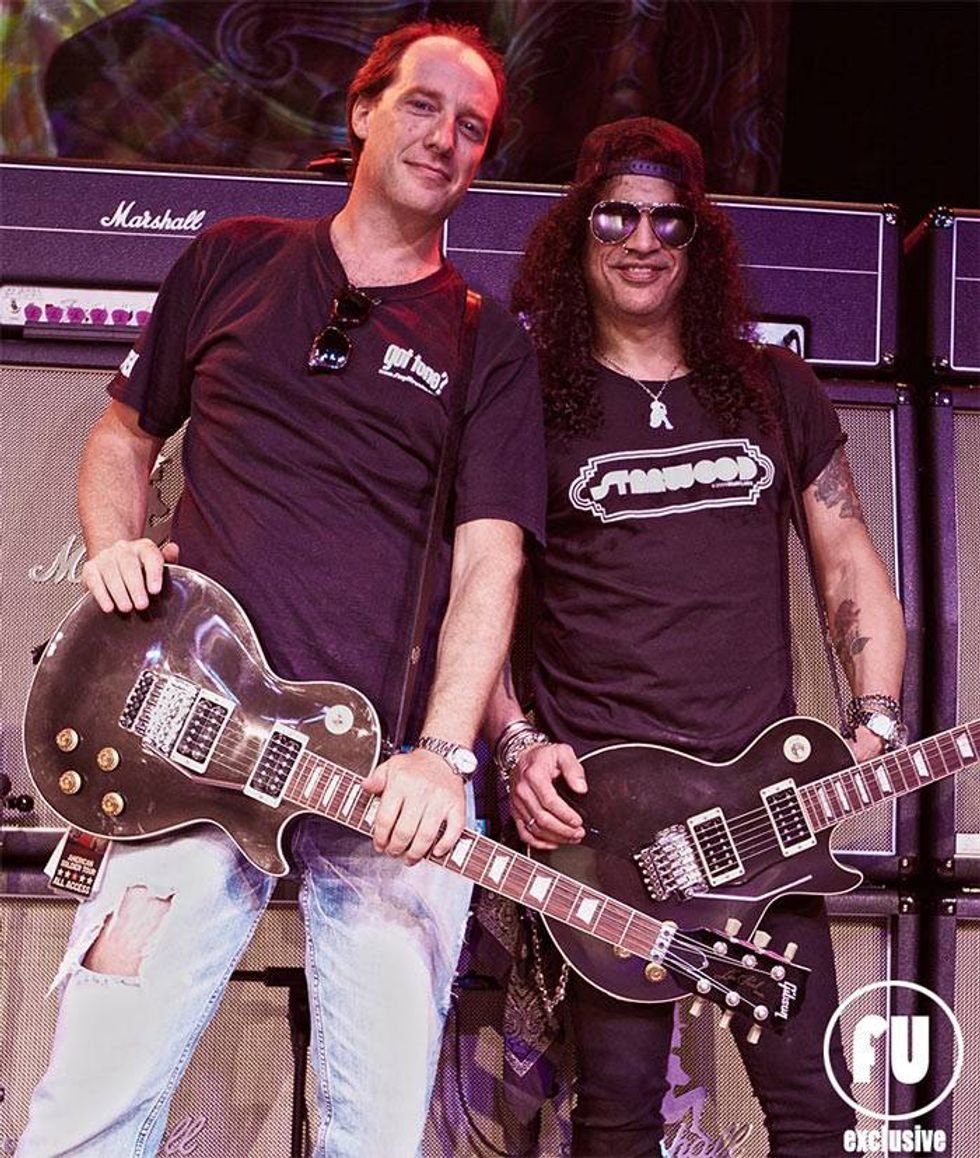
Reiver with Slash
Picture by Nadine Pleasure
“[That process] grew to become a melting pot,” Reiver says. “It might be a type of side-of-the-box conversations. I might say, ‘Effectively, possibly we must always angle it slightly, make this longer, make that shorter, make this, try this.’ I might put it on a guitar, and [Ed] would monkey with it, and say, ‘No, no, no. Do that. Try this.’”
Like Reiver, Van Halen used the guitar as a testing floor, emphasizing fixed refinement in pursuit of maximizing tone. And their early success solely signaled the beginning for Reiver.
“You understand, the appearance of FU-Tone was, ‘How do you make this guitar sound higher? How will you make this maintain extra? How will you make it clearer? How will you make it louder?’ That’s the place it got here from.”
With tone chasing now an obsession, Reiver turned his consideration to a particular piece of {hardware}, one most gamers assumed Floyd Rose had already perfected: the tremolo. The best way Reiver noticed it, the purpose the place the guitar strings terminate within the physique was an important piece of the tonal equation.
“I don’t care in case you play rock, metallic, demise metallic, nation, or pop—you wish to have a very good guitar tone.”
“At first, that was the largest factor, and I began making one product, a 37 millimeter Large Block,” he says. “I used to be like, ‘Wow! It sustains far more, it sounds higher, and it’s extra articulate. Okay, I’ll do that.’ I invested $880 to make a run of the blocks, and mentioned, ‘Effectively, worst-case state of affairs is I may simply give them to my associates, or, you understand, promote them on-line.’”
In idea, the Large Block was exceedingly easy: a bigger, heavier brass tremolo block designed to exchange the smaller inventory variations that got here with most locking techniques. With its elevated mass, it maintained extra string vibration, which translated into extra maintain and articulation.
The Large Block was a success, and shortly sufficient, a few of the world’s most infamous tone-hound guitarists had been spreading the Floyd Upgrades gospel. Reiver realized that if one missed part may make that a lot of an affect, there have been most likely others.
Quickly, he was manufacturing extremely regarded double-locking tremolo alternative components for the most well-liked trem fashions obtainable. From titanium nice tuners to the little metallic inserts present in every saddle, his idea in regards to the impact of mass on tone proved right, time and time once more.
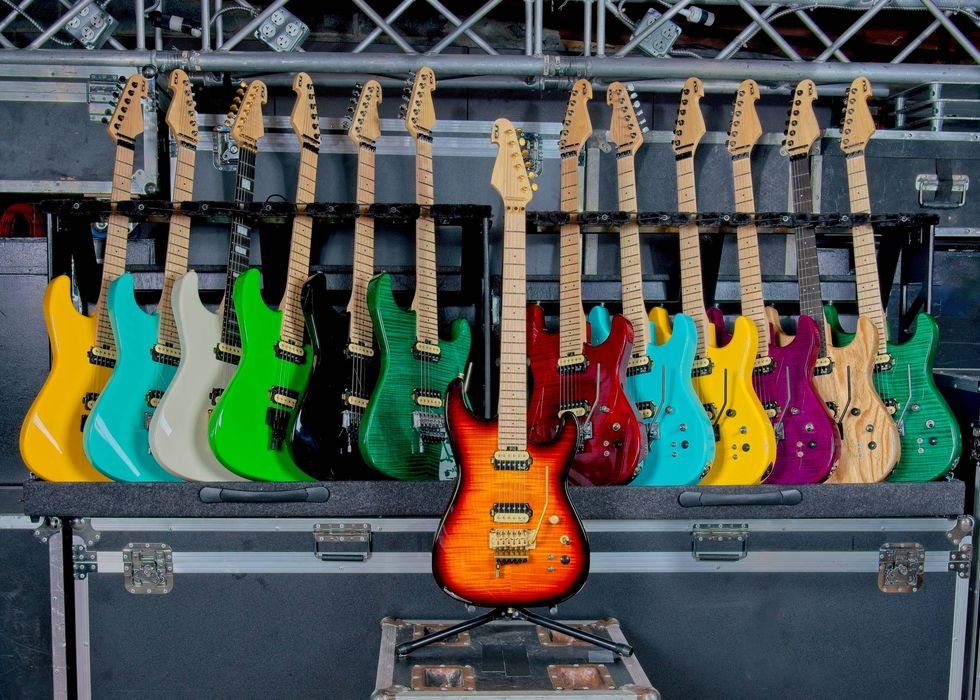
FU-Tone guitars
Picture by Nadine Pleasure
However whereas he was gaining customers, not everybody was a fan of the moniker: Floyd Upgrades.
“A sure firm didn’t like me utilizing a part of their title in my little firm, and that’s truthful sufficient,” Reiver acknowledges. “However the actual blessing in disguise was that I grew to become FU-Tone. And thank god I did, as a result of I ended up occurring to take action many different guitar components and initiatives that don’t have anything to do with another person’s model.”
With a brand new title over the workplace door, FU-Tone was free to innovate and develop a lot additional into the electrical guitar market.
“FU-Tone encompasses lots now,” Reiver says. “I make cease tail bridges. We make Tele components. I make my very own locking tremolos. We make guitars. We even make pickups.”
This relentless growth is about extra than simply product strains. From tiny titanium (or brass or copper) saddle inserts to full guitar builds, each FU-Tone providing nonetheless displays Reiver’s authentic conviction: tone is not tied to any single part, however to how every thing works collectively. It’s what Reiver has characterised because the “FU-Tone vein of tone.”
“I nonetheless pinch myself day-after-day that I get to work with folks I regarded as much as and tried to play like, and now I’m sitting of their residing rooms.”
However what is that tone? Reiver explains: “FU-Tone vein of tone means numerous maintain, readability, and articulation. It’s contemplating the wooden and essence of your guitar, your fingers and your enjoying, after which shifting far past that.”
That concept shifts the dialog away from chasing particular gear and towards understanding how your instrument really responds—the place each materials alternative turns into one other variable within the ultimate sound. So what are you able to count on whenever you swap out your Ibanez Edge tremolo block for a brass or titanium one? What’s the tonal distinction within the metals used of their Nancy Wilson-approved acoustic guitar bridge pins? Without end a gear nerd, Reiver’s all the time pleased to clarify.
“Brass is huge and heat and spherical. Whenever you consider brass, consider Eddie Van Halen, Warren DeMartini, or a George Lynch-type of sound. Titanium has a number of maintain, however with a sure degree of readability to it, virtually like a layer of glass, with very nice notice separation. And copper I discover to be similar to brass, with extra of a scooped-out midsection.”
From icons like Nuno Bettencourt and Slash to trendy gamers like Lzzy Hale and Nita Strauss, numerous A-listers have credited FU-Tone upgrades with having a significant affect on their signature sounds.
However FU-Tone merchandise aren’t only for stars. They’re for all guitar gamers, they usually’re additionally very DIY-friendly. Reiver swears that in case you give him a couple of minutes and watch one of many firm’s detailed how-to YouTube movies, you’ll be customizing your favourite instrument very quickly. “In the event you’ve by no means accomplished any of this, it will probably appear very intimidating,” he says. “However you probably have the flexibility to alter your personal strings, you are able to do this.”
As a guitarist himself, Reiver is aware of firsthand how badly a visit to the native “professional” can go—which is precisely why he’s labored to democratize the method.
“I’ll get a man who will purchase some components and take them to his native man,” Reiver explains, “and he’ll say the identical factor [I always hear]: ‘My man mentioned…’ And I’m considering, ‘Right here it comes!’ I’ve even gotten on a Zoom with guys and walked them by it. And by the tip, they’re higher than ‘their man.’ I inform them, ‘You’ll by no means pay another person to do it once more [laughs].’”
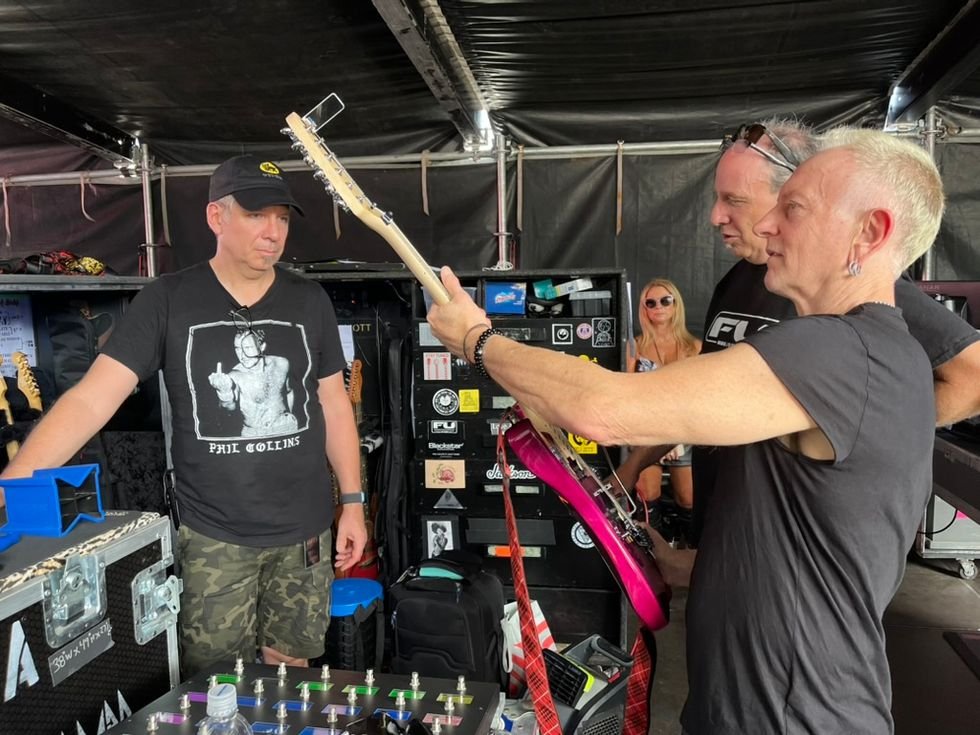
Reiver examines an FU PRO guitar with longtime FU-Tone shopper and pal, Def Leppard guitarist Phil Collen.
Picture by Nadine Pleasure
Private Zoom calls from an organization president aren’t precisely customary apply on this trade. For Reiver, although, that’s the purpose—development by relationships, not conventional advertising and marketing. “I’ve a handful of core guys which are all nonetheless expensive associates to this present day,” Reiver says. “However one of many guys who was there within the very starting was Phil Collen from Def Leppard. After that, my telephone would ring, and it will be some huge artist, and they’d say, ‘Phil has this on his guitar, and mentioned to name you.’”
That sort of connection establishes a degree of belief that may’t be manufactured. And for Reiver and the FU-Tone group, it additionally shapes how these relationships develop.
“These are usually not purchasers—they’re associates,” he says. “We’re at one another’s homes. We’re at one another’s occasions. It’s natural, and it’s actual. I nonetheless pinch myself day-after-day that I get to work with folks I regarded as much as and tried to play like, and now I’m sitting of their residing rooms.” He laughs. “However I play it completely cool.”
With an artist roster that features Gary Holt (Exodus, Slayer) and Michael Wilton (Queensrÿche), it may be straightforward to imagine FU-Tone is strictly for shredders. However Reiver’s merchandise have discovered traction with gamers throughout genres and kinds, and although he’s a rocker himself, he’s persistently shocked by the vary of sounds and approaches the broader FU-Tone group brings.
“I’m not a giant nation fan, however I can let you know, these guys are essentially the most badass musicians,” he says. “We’ll get the blokes in Rascal Flatts, Jim Kimball from Reba [McEntire]’s band, Paul Sidoti from Taylor Swift’s band. I don’t care in case you play rock, metallic, demise metallic, nation, or pop—you wish to have a very good guitar tone. I’ve been doing this for over 30 years, and that by no means will get outdated.”
FU-Tone might function on a world scale, but it surely’s nonetheless rooted in the identical intuition that led a highschool child to begin modifying a price range guitar—and the identical perception that the perfect conversations about tone occur one participant at a time. Which is why, in case you occur to name on a Sunday, you simply would possibly find yourself speaking tone with Adam Reiver.