Synthetic intelligence and data-driven instruments are being utilized to agriculture, from robotics, automation, and precision farming to predictive analytics and digital advisory instruments (Aijaz et al., 2025; Edet and Chowdhury, 2026). These applied sciences are sometimes introduced as methods to enhance productiveness, scale back labor wants, handle danger, and assist farm decision-making. However do farmers themselves see these advantages? Latest surveys in america and Argentina counsel totally different solutions. Each requested farmers an identical query: Eager about synthetic intelligence (AI) or different data-driven instruments, what do you see as the primary profit to your operation? The comparability affords a direct have a look at how producers in two main agricultural economies understand the worth of those rising applied sciences.
Knowledge and Survey Design
This text makes use of knowledge from two producer sentiment surveys: the Purdue College–CME Group Ag Economic system Barometer in america and the Austral College Ag Barometer in Argentina. The U.S. barometer has surveyed no less than 400 agricultural producers month-to-month since October 2015, monitoring present and anticipated financial circumstances, farm funds, funding, farmland values, commerce, and coverage points. The Argentine barometer, developed by the Middle for Meals & Agribusiness at Austral College in Rosario, has surveyed about 400 Argentine producers each two months since 2018, specializing in producer confidence, financial circumstances, funding expectations, and different points affecting agriculture.
For this comparability, we use responses from 400 U.S. producers surveyed in June 2026 and 402 Argentine producers surveyed in July 2026. Each surveys requested an identical query about the primary advantages farmers affiliate with AI and different data-driven instruments. One distinction is that U.S. respondents chosen just one reply (Langemeier & Colussi, 2026), whereas Argentine respondents may choose a number of responses. To facilitate comparability, the Argentine outcomes have been transformed into shares of whole mentions, in order that the classes sum to 100%. Due to this distinction in survey design, the outcomes needs to be interpreted as broadly comparable somewhat than strictly equal.
Perceived Advantages of AI and Knowledge-Pushed Instruments
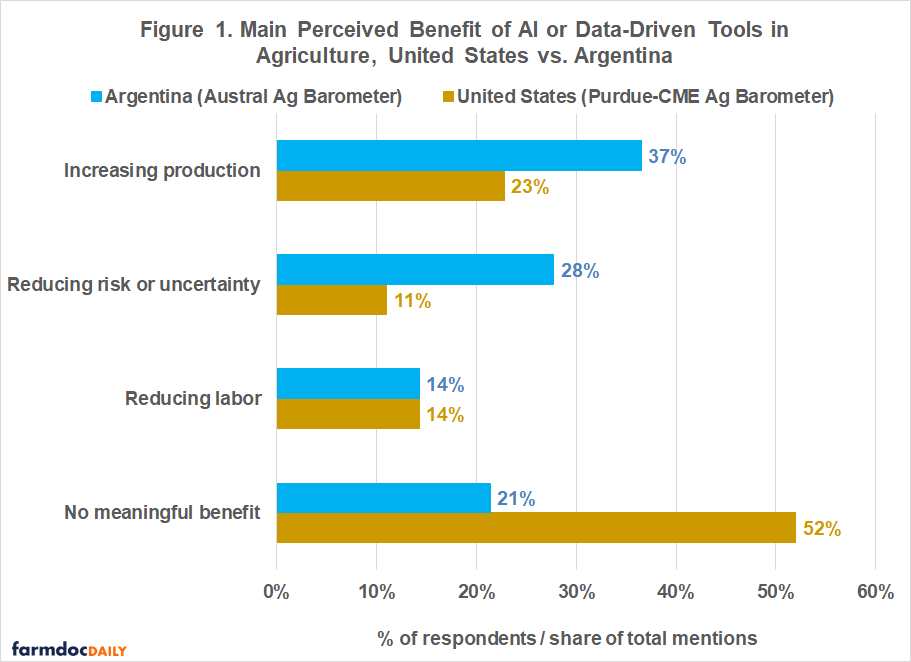
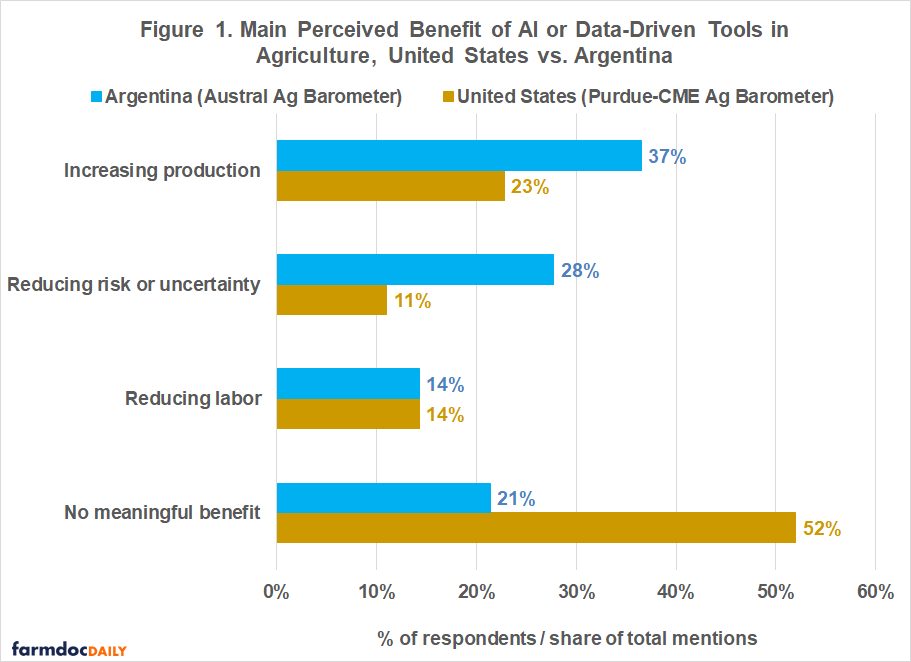
Within the U.S. survey, about 23% of producers recognized elevated manufacturing as the primary profit, 14% cited lowered labor, and 11% cited lowered danger or uncertainty. Greater than half of U.S. respondents (52%) reported seeing no significant profit for his or her operation (see Determine 1). In Argentina, elevated manufacturing accounted for 37% of whole mentions, adopted by lowered danger or uncertainty at 28%, lowered labor at 14%, and no significant profit at 21% (see Determine 1). Total, the Argentine distribution suggests a extra favorable view of AI and different data-driven instruments than the U.S. distribution does, notably when it comes to manufacturing and risk-management advantages.
A associated query additionally pointed to potential usability issues in america: 63% mentioned suggestions generated by data-driven instruments would generally be troublesome to observe, whereas 22% indicated that suggestions would usually be troublesome to observe (Langemeier & Colussi, 2026). Total, Argentine producers seem extra prone to affiliate AI and different data-driven instruments with tangible advantages, whereas U.S. producers are extra skeptical about their worth. The distinction is especially evident in perceptions associated to manufacturing and danger administration, though variations in survey design warrant some warning in deciphering the comparability.
The distinction in AI perceptions additionally seems alongside a broader distinction in producer sentiment between the 2 nations. A current comparability of the 2 barometers, utilizing Could–June averages, discovered that Argentine farmers had a way more favorable medium-term outlook for the crop sector than U.S. farmers (Colussi, Langemeier, and Steiger, 2026). Whereas 57% of U.S. respondents anticipated dangerous occasions for crop producers over the subsequent 5 years, solely 4% of Argentine respondents did (53% of Argentine respondents anticipated good occasions, in contrast with solely 28% of U.S. respondents). Argentine producers have been additionally extra prone to anticipate farmland values to rise over the subsequent 12 months, at 50%, in contrast with 35% in america.
Elements That Could Assist Contextualize the Outcomes
The surveys don’t permit us to find out why perceptions of AI differ between U.S. and Argentine producers, however some elements could assist put the ends in context. One is the broader distinction in producer sentiment mentioned above. Argentine farmers expressed a extra constructive outlook for the crop sector and farmland values. Though the surveys can’t set up a connection between broader producer sentiment and attitudes towards AI, this distinction offers context for deciphering the outcomes.
One other issue is whether or not producers see AI and data-driven instruments as sensible and simple to include into farm decision-making. Within the U.S. survey, most respondents mentioned suggestions generated by data-driven instruments would generally be troublesome to observe. This means that perceived worth could rely not solely on what the expertise can do, but in addition on whether or not its suggestions are comprehensible, related, and simple to combine into present farm operations.
In Argentina, in casual conversations, some farmers have described utilizing AI not a lot as an advisory software however as a option to make sense of the outputs already generated by the assorted apps and platforms they use (i.e., constructing dashboards, evaluating knowledge throughout sources, and integrating in any other case disconnected methods and reviews).
Belief might also play a task. Farmers want confidence within the suggestions generated by these instruments, in addition to readability about how their farm knowledge are collected, used, and guarded (Rowe, 2026). Though the surveys didn’t straight look at these points, they might grow to be essential as AI instruments grow to be extra built-in with farm equipment, administration platforms, and on a regular basis decision-making.
Regardless of variations in farmers’ perceptions of the expertise, the outcomes level to a standard problem: guaranteeing that AI and data-driven instruments ship advantages that producers discover dependable, related, and sensible to include into farm decision-making.
References
Aijaz, N., Lan, H., Raza, T., Yaqub, M., Iqbal, R., & Pathan, M. S. (2025). Synthetic intelligence in agriculture: Advancing crop productiveness and sustainability. Journal of Agriculture and Meals Analysis, 20, 101762. https://doi.org/10.1016/j.jafr.2025.101762
Colussi, J., M. Langemeier and C. Steiger. “How Farmer Sentiment Compares in america and Argentina.” farmdoc day by day (16):150, Division of Agricultural and Client Economics, College of Illinois at Urbana-Champaign, August 20, 2026.
Edet, U. I., & Chowdhury, A. (2026). Social acceptance of huge language fashions in agricultural extension and advisory: a fast evaluation. Q Open, 6(1), qoag001. https://doi.org/10.1093/qopen/qoag001
Langemeier, M., and Colussi, J. “Excessive Enter-Price Considerations Proceed to Weigh on Farmer Sentiment.” Purdue College–CME Group Ag Economic system Barometer, July 7, 2026. https://ag.purdue.edu/commercialag/ageconomybarometer/high-input-cost-concerns-continue-to-weigh-on-farmer-sentiment/
Rowe, J. “How AI Is Enabling Agricultural Intelligence and Revolutionizing Farming.” World Financial Discussion board, January 12, 2026. https://www.weforum.org/tales/food-water-air/ai-agricultural-intelligence-revolutionize-farming/