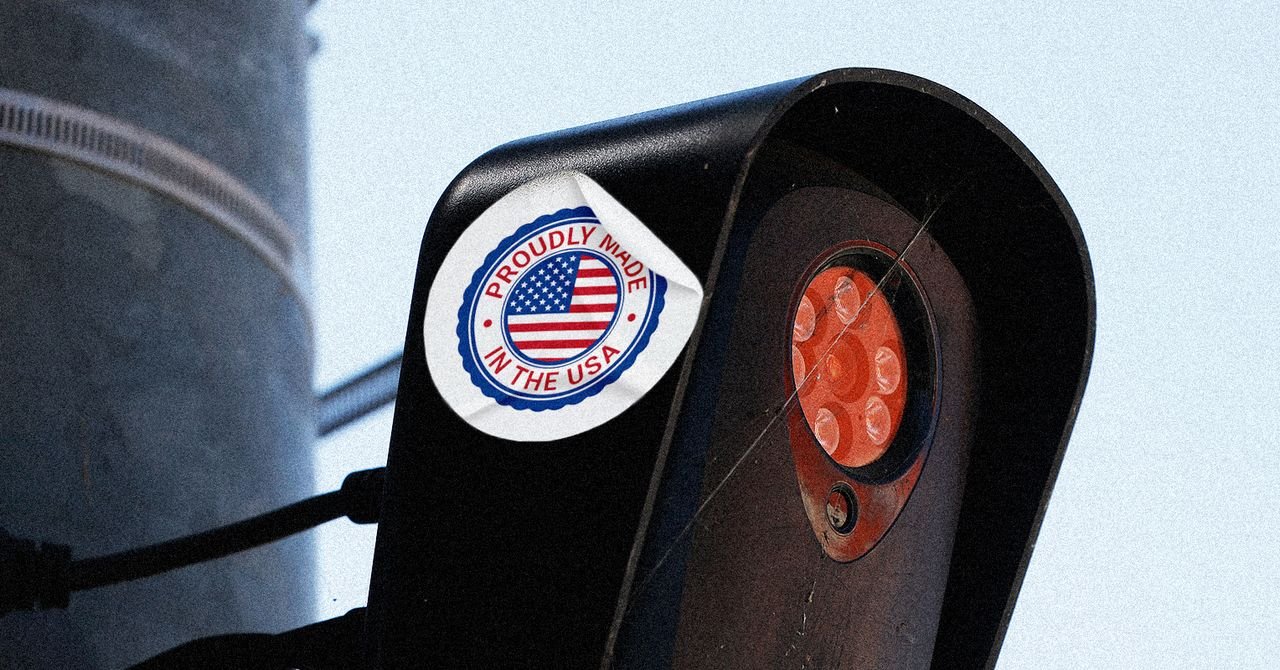
Flock CEO Garrett Langley has stated the corporate made its first license plate cameras in his Atlanta dwelling, completely scratching his eating desk with drill marks. A decade later, the place the corporate assembles its signature—and fiercely debated—product has grow to be extra of a thriller.
For years, Flock touted publicly that its units have been produced in the USA. However newer advertising supplies from the corporate reviewed by WIRED not specify the place its cameras come from. One US producer that beforehand recognized Flock as a buyer quietly eliminated a point out of the corporate from its web site earlier this yr as public backlash in opposition to the corporate’s surveillance know-how grew.
The startup has grow to be the topic of a nationwide protest motion that has prompted dozens of native governments to abruptly cease utilizing its cameras. Congress can also be contemplating laws that may minimize federal funding to states that fail to restrict use of Flock and different license plate readers. Whereas police have argued the cameras are essential instruments for deterring and fixing crime, activists have criticized Flock for enabling officers to observe the automobiles of their exes, share footage with immigration authorities, and comply with the actions of pedestrians.
However Flock’s manufacturing provide chain has obtained scant consideration, regardless that the place its {hardware} is produced might have implications for US nationwide safety. WIRED spoke with present and former Flock workers and provide chain analysts, reviewed information from US import information, and watched previous advertising movies that includes Langley to piece collectively the primary account of how its {hardware} pipeline has advanced.
Flock’s cameras largely depend on suppliers world wide that present non-custom elements, that are additionally utilized in merchandise from different corporations. “Our worth is within the aggregation and the packaging of all of these items … in a pleasant waterproof, consumer-friendly system,” Langley stated in a single advertising video from 2021.
Import information collected by ImportGenius present the corporate has been more and more bringing “commodity” cameras, radar techniques, and different parts over from Primax Electronics in Thailand. Primax relies in Taiwan, however has manufacturing amenities in China, Thailand, and elsewhere.
“My understanding is that these are parts, however it appears like Primax manufactures complete safety digicam options,” ImportGenius’ analyst Lynn Hughes says. “Fairly a couple of shipments embody ‘Radar’ within the product description which could be associated to the radar sensor pods they’re attaching to their cameras.”
Flock didn’t reply to many of the detailed questions WIRED requested for this story, although it did present some normal data. “All merchandise that Flock builds are Nationwide Protection Authorization Act compliant,” Flock spokesperson Paris Lewbel stated in an e-mail, referring to a US regulation that successfully bars authorities contractors from utilizing elements made by a handful of Chinese language tech corporations over safety issues.
Cris van Pelt, creator of the anti-Flock advocacy challenge Have I Been Flocked, says that whereas the place the cameras are made might have comparatively minor implications for US communities, the dearth of transparency about their origins underscores a broader drawback.
“All of it speaks to the truth that there isn’t any actual oversight, and that tens of hundreds of literal and figurative black packing containers are being put in on American roads,” van Pelt says. “If any a part of the availability chain is compromised, we might by no means know. That’s a a lot greater drawback than the place the ultimate product is assembled.”
“Aggregation”
The earliest Flock prototypes have been made utilizing cameras ripped out of Android telephones purchased on Alibaba, which have been then connected to batteries and soldered onto a photo voltaic panel, Langley recalled in a single video. The purpose was to show {that a} helpful system might be created from elements collectively costing between $200 to $300. (WIRED reported earlier this week that Flock’s cameras proceed to make use of smartphone-style processors and go away important information unencrypted.)
As Flock started securing contracts with owners associations, it shifted into a company workplace that additionally doubled as an meeting line. Langley described the setup as enjoyable, but in addition unprofessional and arduous—pallets of elements shipped in from China needed to be dragged 1 / 4 of a mile by the constructing a number of instances every week.