The skirmishes between the colonies and England in April 1775 grew right into a full-on battle by January of 1776. Now not contained to New England, the preventing had unfold to Canada and the South; a lot in order that British loyalist and Virginia’s royal governor Lord Dunmore provided freedom to any enslaved man who fought on behalf of the Crown.
The stakes had been excessive.
The colonies had been not interested by making good with England. They wished independence and realized they needed to unite to win.
Stephen Moylan, a Pennsylvanian and officer within the Continental Military first floated the thought of calling the brand new nation the “United States” in a 1776 letter to politician and comrade in arms Joseph Reed.
“Moylan wrote the ‘u.s.’ wanted to spend emissaries to Spain and construct a case for the rising revolution and safe overseas help,” defined Matthew Skic, director of collections and exhibitions at the Museum of the American Revolution.
”That letter, dated Jan. 2, 1776, is the primary documented reference to the colonies because the ‘u.s.’,” Moylan mentioned.
Eight days afterward Jan. 10, Frequent Sense, Thomas Paine’s revolutionary 74-page pamphlet urging the colonies to kind an unbiased empire, dropped.
The pamphlet, learn aloud in taverns in colonial Philadelphia and all through the unique colonies, stoked the flames of independence. It was printed in Robert Bell’s print store at Third and Walnut Streets.
“Paine urged the colonies to kind states,” Skic mentioned. “However not the twenty first century perspective of states as in New Jersey, Virginia, or New York. Within the 18th century, states had been an unbiased nation or nation with its personal authorities.”
And people states, Paine mentioned, wanted to come back collectively to defeat a typical enemy: England.
In Might 1776, Virginia statesman Richard Henry Lee issued a decision proposing the Second Continental Congress declare the colonies’ independence, explicitly stating that the brand new nation ought to include unbiased states previously often called colonies.
On July 2, the Second Continental Congress adopted the Declaration of Independence that referred to the brand new nation because the united States. The united was written in lowercase, Skic mentioned, to emphasise the deal with “States.”
Nonetheless, it wasn’t till Sept. 9 when in the course of the Second Continental Congress — assembly on the Pennsylvania State Home, immediately’s Independence Corridor — delegates voted to name the brand new authorities the USA of America, with a capital “U”.
“As quickly as independence turns into the aim, not simply restoring liberty, the USA took maintain as a reputation,” Skic mentioned. “And it occurred in a neat six month time interval.”
The official naming of the USA shall be remembered Saturday at Independence Corridor from 11 a.m. to 1 p.m. within the Philadelphia Historic District’s thirty eighth firstival. Firstivals are weekly day events held in honor of America’s 250th birthday.
“The Continental Congress had been making an attempt to determine the way it ought to represented after we current ourselves to different nations,” Skic mentioned. “What can be the official seal on our authorities paperwork? With the Sept. 9 vote, Congress formally says all the authorities’s official paperwork will say ‘United States.’”
The Continental Congress ordered the Continental Military’s property be marked United States in February 1777.
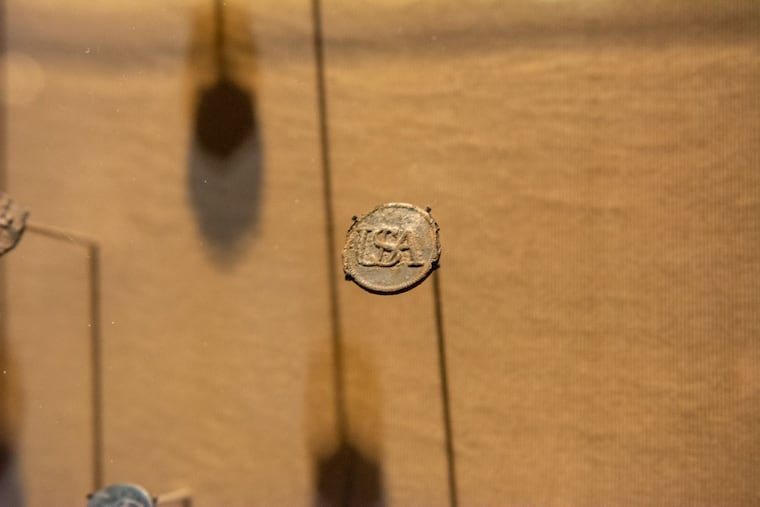
“[The Museum of the American Revolution] has muskets, canteens, and cartridge containers marked U. States,” Skic mentioned. “We even have the one surviving authentic mildew for the colonial USA buttons.”
The military can be known as the Continental Military via the top of the Revolutionary Warfare in 1783, after which it disbanded. George Washington was elected president in 1789 and shortly after his inauguration, it was reestablished as the USA Military.
This week’s Firstival is Saturday, Sept. 19, from 11 a.m.-1 p.m., at Independence Corridor, 520 Chestnut Road.
Every week, The Inquirer is highlighting a “first” from the Philadelphia Historic District’s 52 Weeks of Firsts. A “52 Weeks of Firsts” podcast, produced by All That’s Good Productions, drops each Tuesday.